






POS Hardware for BBQ Restaurants Built for Heat Grease and High Volume

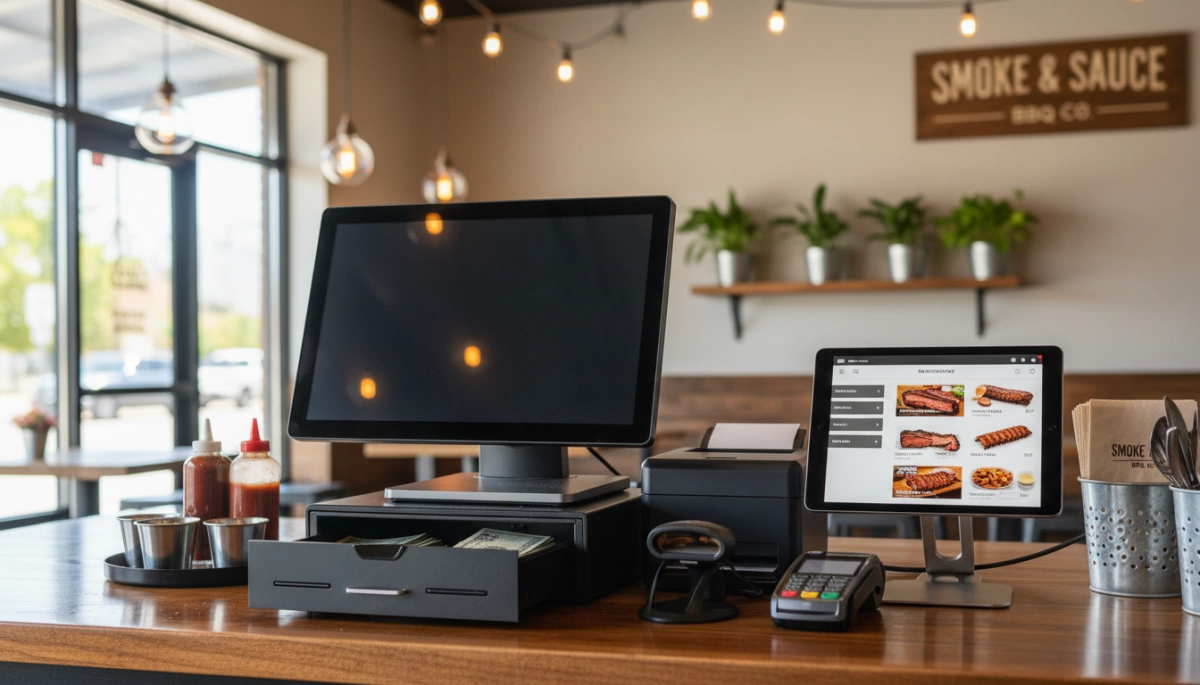
Why Standard POS Hardware Fails in the Smokehouse
The Hidden Costs of Grease, Heat, and High Volume
Have you ever tapped a screen with a gloved, slightly greasy hand, only to have the system freeze up mid-order? Or watched your terminal slow down to a crawl right when the dinner rush hits and the kitchen temperature spikes? These aren’t just annoyances; they are critical failures that cost you revenue. At SDLPOS, we understand that POS Hardware for BBQ Restaurants faces a brutal environment that standard retail terminals simply cannot survive.
A typical consumer-grade tablet or lightweight plastic register is designed for air-conditioned retail counters, not the intense reality of a smokehouse. When you place standard hardware near a pit or a hot pass, you encounter specific failure points:
- Thermal Throttling: Consumer processors (CPUs) automatically slow down to protect themselves when exposed to the ambient heat of a kitchen or proximity to heat lamps. Our industrial-grade POS terminals utilize enhanced heat dissipation designs to maintain peak processing speed, even in high-temperature zones.
- Grease Infiltration: Airborne grease and smoke particles settle on internal components, acting as insulators that trap heat and eventually corrode circuits.
- Touchscreen Unresponsiveness: Standard screens often fail to register touches from wet or greasy fingers. You need a grease-resistant touchscreen with industrial capacitive technology that responds accurately every time, ensuring your line keeps moving.
Investing in generic equipment might save money upfront, but the cost of a system crash during a Friday night brisket rush is far higher. You need durable restaurant POS hardware engineered for 24/7 operation in demanding commercial environments, not a device that needs a break when the heat turns up.
The Weighing Scale Cash Register: A BBQ Necessity
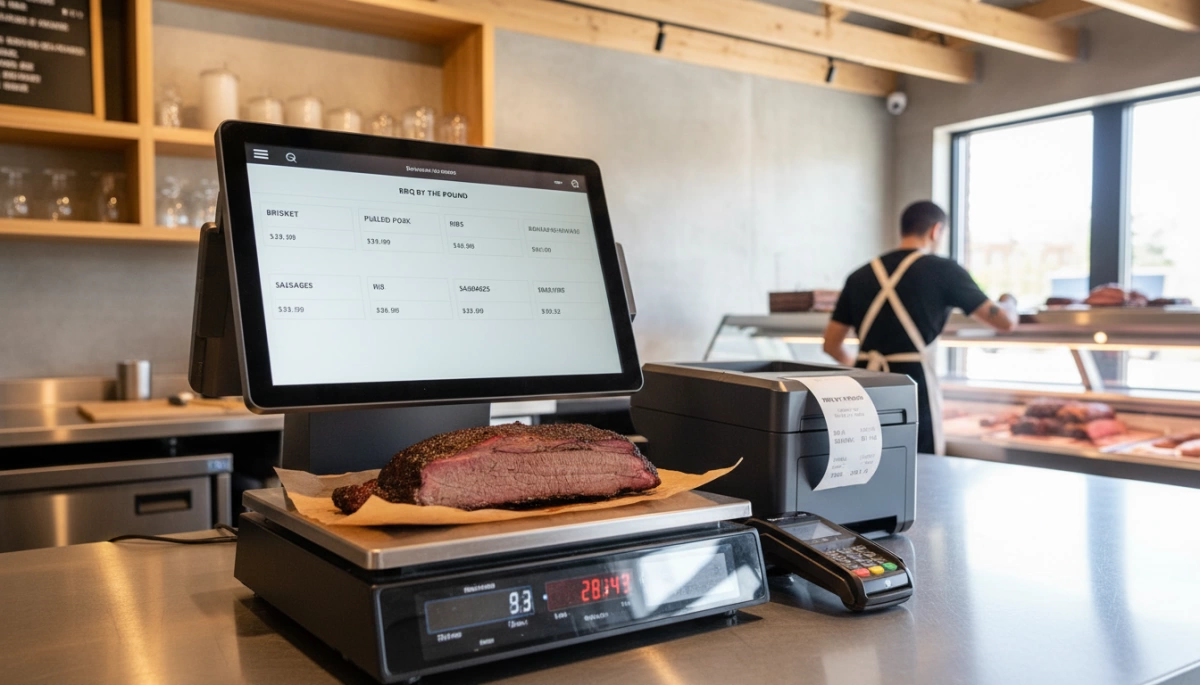
If you run a smokehouse, you know the drill: customers want half a pound of moist brisket, three ribs, and a side of pulled pork. Trying to calculate these variable prices manually during a lunch rush is a recipe for disaster. That is why a weighing scale cash register is the heartbeat of any authentic BBQ joint.
We provide integrated scale POS hardware that streamlines the entire “meat by weight” process. You simply place the tray on the scale, and the system automatically calculates the price based on the weight. This eliminates human error and stops your staff from accidentally undercharging for premium cuts. Understanding how a cash register system works when paired with precision scales ensures your inventory matches your sales data perfectly.
Why an Integrated Scale is Critical for BBQ:
- Speed: Instant weight-to-price calculation keeps the line moving fast.
- Accuracy: Stops cashiers from typing in the wrong weight manually.
- Transparency: A dual-screen customer display lets the customer see exactly how much their tray weighs, building trust.
- Durability: Our scales are built to withstand the occasional drip of BBQ sauce or grease.
For high-volume spots, we often recommend a scanner-scale combo. This lets you weigh the hot food and scan a soda bottle in the same motion, making it the ultimate meat by weight POS solution.
Durability Check: Hardware Built for the Pit
In a busy smokehouse, standard consumer electronics often fail quickly. The combination of high ambient temperatures from the pit and airborne grease particles can overheat processors and clog internal components. We engineer our Industrial-grade POS terminals specifically to withstand these demanding commercial environments where reliability is non-negotiable.
When evaluating critical factors to consider when choosing POS hardware, resistance to environmental stress is the most important metric for BBQ restaurants. Our hardware is built to handle the heat and keep the line moving.
Key Specs for Smokehouse Survival
- Heat-Resistant POS Hardware: Our units feature enhanced heat dissipation designs. This prevents thermal throttling and system crashes, even when the ambient temperature in the service area rises.
- Grease-Resistant Touchscreens: We utilize 15.6″ capacitive touchscreens designed for accuracy. These screens register touches precisely, even if a server’s hands are slick from handling trays or brisket, ensuring orders are entered correctly every time.
- 24/7 Industrial Operation: Unlike consumer tablets that need downtime, our Durable restaurant POS systems are built with industrial-grade components (like RK3568 or Intel processors) designed for continuous, round-the-clock operation.
- Solid State Storage: We use high-speed M.2 SSDs which have no moving parts, reducing the risk of failure caused by vibration or dust ingress compared to traditional hard drives.
Handheld Terminals and Mobile Ordering: Busting Long Lines and Tableside Service
In the BBQ business, a long line outside the door is a badge of honor, but a slow-moving line inside kills revenue. We provide line-busting handheld POS devices that allow your staff to step out from behind the counter and take orders directly in the queue. By the time the customer reaches the register, their order is already fired to the kitchen, and payment is the only step left. This mobile approach significantly reduces wait times and increases table turnover during peak lunch rushes.
Unlike consumer smartphones that crack easily, our durable restaurant POS handhelds are built for the harsh reality of a smokehouse. They feature industrial-grade casings that withstand drops on concrete patios and screens that resist grease and sauce smears. Adopting these rugged mobile tools is a critical step in embracing the future of retail hardware technology and hospitality efficiency.
Key Features for Mobile BBQ Operations:
- Integrated Scanners: Built-in 2D barcode scanners allow for instant scanning of loyalty QR codes or coupons, speeding up the checkout process.
- Team Ordering: Servers can input orders tableside, sending tickets instantly to the pit, eliminating the need to run back and forth to a stationary terminal.
- Offline Mode Capabilities: Our hardware supports software with offline mode POS functions, ensuring you can keep selling at outdoor catering events or festivals even without a stable internet connection.
- Long Battery Life: Designed for commercial shifts, these units run all day without needing a recharge mid-service.
Kitchen Display Systems (KDS) vs. Greasy Paper Tickets
Anyone running a smokehouse knows the struggle of paper tickets in the pit. Between the humidity, the heat, and the constant flow of sauce, paper tickets get lost, stained, or become unreadable. This leads to missed orders and angry customers. That is why a Kitchen display system KDS is becoming standard equipment for high-volume BBQ joints across the US.
We supply hardware that replaces the “spin and stick” ticket rail with industrial-grade screens. Unlike a standard consumer monitor, heat-resistant POS hardware is designed to function reliably even when the kitchen temperature spikes near the smokers. You cannot risk your screen overheating and shutting down in the middle of a lunch rush.
Why Industrial KDS Hardware Wins in the Pit:
- No More Ghost Tickets: Paper tickets don’t fall behind the counter. Digital orders stay visible until they are bumped.
- Sealed Enclosures: We recommend grease-resistant touchscreen monitors or units paired with rugged bump bars. These are built to be wiped down instantly without damage.
- Smoke Protection: Smoke residue is sticky and conductive. Our industrial screens often feature fanless designs to prevent pulling greasy air into the internal components.
- Clear Modifiers: Specific requests like “lean cut” or “sauce on side” are bolded and highlighted, drastically reducing food waste.
While some pitmasters still like the sound of a kitchen printer, the reliability of digital hardware is unmatched. Understanding the efficiency gains here parallels the differences between a traditional cash register vs. POS system, where modern tech simply handles the volume better. If you are pushing hundreds of pounds of brisket a day, your hardware needs to be tough enough to survive the environment.
SDLPOS Hardware Solutions for BBQ Joints
At SDLPOS, we build industrial-grade POS terminals designed to survive the unique challenges of a smokehouse. With over 15 years of manufacturing experience and a monthly capacity of 20,000 units, we know that standard consumer electronics cannot handle the heat and grease of a busy BBQ kitchen. Our systems feature enhanced heat dissipation designs and industrial components meant for 24/7 operation, ensuring your BBQ restaurant POS system never overheats or crashes during the dinner rush. Unlike basic plastic setups, we understand the critical difference between entry-level vs. premium POS hardware when it comes to longevity in harsh commercial environments.
We offer full OEM/ODM customization services for franchises and software providers. Whether you need specific port configurations for legacy peripherals or custom branding for a multi-location chain, we can tailor the hardware to your exact specs. Our units support standard SDKs for seamless software integration, providing a truly custom POS hardware solution that fits your operational flow.
Recommended Configurations for Smokehouse Workflows
| Hardware Type | Key Specs | Best Application |
|---|---|---|
| Android All-in-One | RK3568 Processor, Android 11 | High-volume counter service and fast transactions. |
| Windows Performance | Intel Core i7 (10th Gen), M.2 SSD | Complex server stations and heavy inventory management. |
| Integrated Scale POS | Built-in weighing module | Selling meat-by-weight (brisket, ribs) directly at the register. |
| Dual-Screen Terminal | 15.6″ Main + Customer Display | Verifying orders and showing promotions to customers in line. |
If you are outfitting a location from scratch, reviewing a comprehensive POS guide for new store owners can help ensure you select the right mix of terminals and peripherals. We back all our equipment with ISO 9001, CE, and FCC certified quality control, ensuring every unit leaving our factory is ready for the pit.
Comparing Hardware: Consumer Tablets vs. Industrial POS
In the high-traffic, greasy environment of a BBQ joint, the allure of cheap consumer tablets often fades quickly. While an iPad or standard Android tablet might look sleek on the counter, they simply aren’t engineered for the punishment of a commercial kitchen or smokehouse service area. As a manufacturer, we see the difference in longevity and performance every day.
Why Rugged Equipment Wins on ROI
Investing in an industrial-grade POS terminal upfront delivers a better Return on Investment (ROI) than constantly replacing fragile consumer electronics. Here is why purpose-built hardware outperforms standard tablets in a BBQ setting:
- Heat Dissipation: Consumer tablets are designed for casual use, not 24/7 operation next to a hot pit. They often overheat and throttle performance. Our hardware features enhanced heat dissipation designs and low-power consumption processors (like the RK3568 or Intel J6412) to stay cool and fast under pressure.
- Connectivity without Dongles: A durable restaurant POS needs to connect to receipt printers, cash drawers, and scales simultaneously. Consumer tablets require fragile dongles and adapters that fail easily. Our terminals come with native interfaces for seamless integration.
- Built for 24/7 Operation: We use industrial-grade components meant to run all day, every day. Consumer batteries swell and screens fail when left on permanently.
- Grease Resistance: Capacitive touchscreens on industrial units are built to withstand greasy fingers and frequent cleaning, whereas consumer screens can become unresponsive or suffer from “phantom touches.”
For businesses looking to scale, choosing a specialized OEM cash register ensures you get hardware tailored to these harsh conditions rather than a generic device that will fail during the Friday night rush. The initial savings on a tablet disappear the moment your system goes down during service.
FAQ: Common Questions About BBQ POS Hardware
We hear a lot of the same concerns from pitmasters and restaurant owners looking to upgrade their setup. When you are dealing with high-volume lunch rushes and messy ingredients, you need straight answers. Here is the lowdown on durability, integration, and keeping your BBQ restaurant POS system running smooth.
Can standard tablets handle the heat and grease?
Honestly, consumer-grade tablets usually struggle in a real smokehouse environment. A grease-resistant touchscreen is non-negotiable when your staff has sauce on their hands. Unlike standard consumer tech, an industrial-grade POS terminal is built with IP-rated sealing to stop brisket grease and dry rub dust from frying the internal circuits. Choosing the right interface is critical; comparing touch POS vs keypad POS reveals why sealed touchscreens often outperform mechanical buttons that trap sauce and debris.
How does an integrated scale work for meat-by-weight?
Speed is everything. An integrated scale POS connects directly to your terminal. When you weigh a pound of ribs, the weight sends the price straight to the bill. You don’t type it in manually. This cuts down on human error and speeds up the line significantly. We always recommend a weighing scale cash register configuration for any joint selling by the pound.
What happens if the internet goes down?
You can’t stop serving just because the Wi-Fi blinks. You need offline mode POS capabilities. Your hardware should store transaction data locally and sync it back up once the connection returns. Reliability is key, much like other specialized cash register systems for restaurants and cafes where downtime simply isn’t an option during a rush.
Maintenance Tips for Longevity
- Wipe, Don’t Spray: Never spray cleaner directly on the screen. Spray a cloth, then wipe the anti-smudge coating.
- Check the Vents: Even heat-resistant POS hardware needs to breathe. Ensure receipt printers and terminals aren’t shoved into corners where airflow is blocked.
- Cable Management: Keep cables tied back to prevent accidental disconnects during a busy shift.